2nd Military Railway Service HQ Boyd W. Stone

Thanks to Don Stone for this great indformation on his grandfather, Maj. Boyd W. Stone, Sr., of the 2nd MRS 

 In 1943 our Dad was drafted into the Army. Soon after, Gramps volunteered for the Army (Gram’s reaction to this decision is still echoing off the buildings on Ashland Ave. in St. Louis) and was commissioned a Captain in the 2nd Military Railway Unit, Headquarters Company. The 2nd Military Railway Unit was to be in charge of all railway transportation in northern France after the D-Day invasion. After training at a post that no longer exists outside of New Orleans, the unit went to England to await D-Day. 

On D+11 (eleven days after June 6, 1944) an advance party of 2nd MRS personnel (inlcuding Gramps) went into France through the Normandy beachhead. Some days thereafter Gramps was shot by a sniper, becoming the first casualty in his unit, and was medically evacuated back to England. His wound was the equivalent of his 3rd Purple Heart (I say “equivalent” because he wasn’t awarded “wound stripes” for his injuries in WW I because he didn’t go to a hospital).

Stories behind the stars and research done for repatriation of WWII Fallen Soldiers Using DNA and Genealogy Research

I'm going to start working on a World War II Army rail-man killed in action death project.

How to Tell 400,000+ WWII Fallen Stories in 36 Months


749th Railway Operating Battalion-World War II thanks Jud Hulon


G. I. Railroaders "Train" for combat R.I. Lines


Last train home ..


After World War II, fallen American service personnel rode the rails to their resting places ON THE CALENDAR, World War II ended with Japan’s surrender on September 2, 1945. 

For millions of American military personnel who made it through the hostilities, the duration dragged on into 1946. However, for the families of more than 279,000 Americans who died overseas, the war continued until loved ones reached their final resting places. Often this was through a U.S. Army program repatriating deceased servicemen and women aboard mortuary trains that in their day were front-page news but now are forgotten. The Army dispatched the first rail cars in this unique troop movement at Oakland, California, on October 13, 1947, attaching U.S. Army Transportation Corps mortuary cars to civilian passenger trains bound for five of 15 distribution centers serving the continental United States. For four years in that pre-television era, mortuary cars, sometimes making up an entire train, reminded Americans of the price that their compatriots had paid to maintain freedom.

read on HERE

733rd Railway Operating Battalion has men from 109 railroads


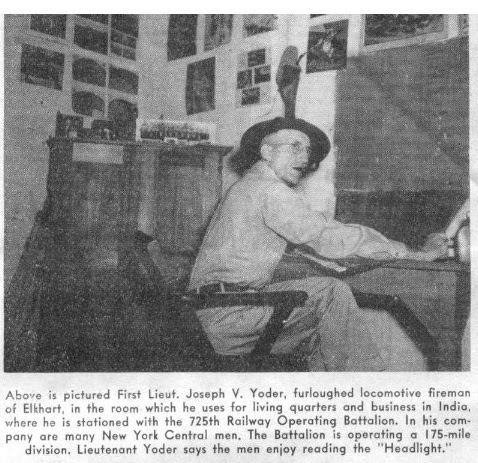
725th Railway Operating Battalion - Yoder in India

Unknown Rail unit housing Belgium photos 1944-45

743rd Railway Operating Battalion Womack article Green Diamond journal


712th TBRO Transportation Railway Operating Battalion Timetable 3RD TRC Korean National Railroad

711th Railway Operating Battalion lighter

706th Railway Grand Division Letters- Waters

1st Railroad detachment 1978 deactivited was 714th ROB

Highlights of the history of the 709th Railway Grand Division : covering period, March 15,1944-May 8th, 1945 by Albert W. Spratley

Yankee Boomer Vol 1 No. 1 the very first issue October 1943