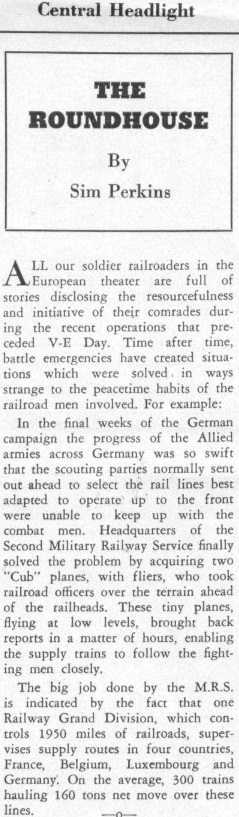
"One Railway Grand Division controls 1,960 miles of railroad tracts in 4 countries "
Railway Operating Battalion (ROB), Railway Shop Battalion (RSB), Railway Grand Division (RGD), Transportation Railway Shop Battalion (TRSB), Transportation Group (Railway), Transportation Railway Shop Battalion (TRSB), Transportation Railway Operating Battalion (TROB), Transportation Military Railway Service(TMRS), Transportation Group (Railway), Transportation Corps, U.S. Army and more
"One Railway Grand Division controls 1,960 miles of railroad tracts in 4 countries "
Sunday, January 01, 2023 | Labels: Central Railroad Headlight | 0 Comments


Saturday, December 24, 2022 | Labels: 2nd Military Railway Service, Christmas | 0 Comments
part 2
The attached article, which is the 1st Part of a 2-Part Series, describes some of the methods used by the US Army Engineer Battalions and Military Railroad Operating Battalions to rebuild wrecked railway bridges in Italian Theater during the 1943 and 1944 period. The Wehrmacht demolished numerous Italian Railway bridges during their retreats and these required extensive repairs by the Allies in order to return the railways to operation. The original article was printed in the December 16, 1944 edition of the USA railroad industry magazine 'Railway Age’. Thanks Richard
Saturday, December 10, 2022 | Labels: 701st Railway Grand Division, 703 Railway Grand Division, 704th Railway Grand Division | 0 Comments
March 1943. "Clovis, New Mexico. Private Clarence Stephens of Streator, Illinois, a member of the U.S. Army Railroad Battalion stationed at Clovis, with Sidney Mack, engine inspector at the Atchison, Topeka and Santa Fe Railroad shops. They are inspecting one of the 5000 Class freight engines." Acetate negative by Jack Delano, Office of War Information

Probably the 713th---The 713th Railway Operating Battalion was formed on March 12, 1942, and consisted entirely of men who worked for the Atchison, Topeka, and Santa Fe Railroad. Their job was to clear, repair, and build military railways as well as operate the trains.
The 713th, known as the “Santa Fe Battalion”, formed at Camp Clovis, New Mexico, and after initial military training was sent to Camp Dix, New Jersey, on January 21, 1943. The unit was first sent to North Africa where in seven months they transported 500,000 tons of cargo in 47,255 rail cars. The 713th went from North Africa to Italy and then on to Southern France. They ended the war in 1945 serving in Western Germany.
Monday, November 14, 2022 | Labels: photos, Railroad company, Santa Fe Railroad | 0 Comments
Railways at War Part 1
Part 2 https://drive.google.com/file/d/1BpXsOUAKH8OtQYnnbvDkPmH2o8AV21nA/view?usp=sharing
Part 3 https://drive.google.com/file/d/15xAKQ4a_gjCOXMn2mPUfmmoF5x8Ryxl0/view?usp=sharing
Saturday, November 12, 2022 | Labels: book | 0 Comments
Saturday, November 05, 2022 | Labels: 712th Railway Operating Battalion | 0 Comments

Although not a railway history volume the book ‘Oxwich To Omaha, American GIs in South Wales’ by Phil Howells (self-published, no ISBN, revised edition 2021) has much to recommend it on a num-ber of counts. Firstly, it is more about South Wales and the Bristol Channel/Severn Estuary area as a whole with Avonmouth, Sharpness etc. so it is more a case of South Wales plus. Secondly, a lot of information concerning rail movements and US Army locomotives can be found although this requires searching through the text, nor are the maritime/shipping aspects neglected which is of major relevance as the major South Wales docks were owned by the Great Western Railway. Perhaps most important is that the book is based on extensive research in the US National Archives. Consequently, it is a who, what, where, when and how book rather than the more usual anecdotal accounts of the ‘Yanks’ derived from ‘oral history’ and ‘family tradition’ which are often recorded decades later, uncorroborated and of doubtful provenance. This book contains masses of detail based on documentary evidence and should interest anyone interested in Britain’s railways in WW2 and/or the US Army presence in Britain during the same period. Copies of the revised 2021 can be obtained through Amazon for £12.99 which is extremely good value given the sheer amount of data included. South-west England and South Wales were the main concentration areas for US ground forces under the BOLERO programme in the build-up to D-Day and they were critically dependent on the railways. Nothing comparable seems to be currently available elsewhere. MILITARY RAILWAY STUDY GROUP https://www.mrsg.org.uk/
~~~~~~~~~~~~~~~~~~~~~~~
Saturday, November 05, 2022 | Labels: book, locomotives | 0 Comments
U. writes...
Grandpa Karl worked as a locomotive fitter for the German State Railway until 1. April 1941 , then he had to move to the army.
Till end of war in 1945 , he worked at the " Atlantikwall " in Belgium and France and drove trains at different places in Europe .
Due to his profession, he got his certificate of discharge in June 1945 and than he started to work for/with the 740th railway op bat. at Bonn /Germany , where a railhead was build. The permit on the photo is from this time.

Thanks U glad to see Grabdpa Karl's IS card
Monday, October 31, 2022 | Labels: 740th Railway Operating Battalion | 2 Comments

Monday, September 12, 2022 | Labels: 757th Railway Operating Battalion, 757th Railway Shop Battalion | 0 Comments
Wednesday, June 22, 2022 | Labels: Military Railway Service Journal | 0 Comments
Wednesday, June 22, 2022 | Labels: Military Railway Service Journal | 0 Comments
Wednesday, June 22, 2022 | Labels: Military Railway Service Journal | 0 Comments
Wednesday, June 22, 2022 | Labels: Military Railway Service Journal | 0 Comments
Wednesday, June 22, 2022 | Labels: Military Railway Service Journal | 0 Comments
Wednesday, June 22, 2022 | Labels: Military Railway Service Journal | 0 Comments


If you have any materials connected to these great Army Railway units please share them here with the families of the soldiers. If you are a collector or memorabilia dealer PLEASE share copies or scans of items BEFORE you sell these priceless materials to private collectors . I will hold the copies until after they sell. It means so much to the families of the guy's that actually served in these units.
Contact me : Nancy militaryrailwayservice@gmail.